
Coyolxauhqui: The Dismembered Mexica Goddess Who Refuses to Be Forgotten
There are some deities whose stories survive neatly. Coyolxauhqui is not one of them. Her body is broken.
Her story comes to us through sources created in the complicated aftermath of conquest, through surviving images, through archaeology, and through a massive stone body that spent centuries beneath Mexico City. And perhaps that is why she continues to fascinate people.
Today, Coyolxauhqui is frequently described online as an “Aztec moon goddess.” Sometimes she becomes a goddess of feminine empowerment, shadow work, healing after trauma, rebellion, or putting oneself back together after being broken. Those interpretations may hold meaning for modern practitioners, but they are not the whole historical story.
To understand Coyolxauhqui, we have to return to Mexico-Tenochtitlan, to the sacred mountain of Coatepec, to Coatlicue and Huitzilopochtli, and eventually to the foot of the Templo Mayor itself. Because the Mexica did not simply tell the story of Coyolxauhqui, they built it into their sacred landscape.
First: Mexica or Aztec?
Before we get into her story, we need to talk about terminology. Most people have heard the phrase “Aztec gods.” “Aztec” is useful as a broad modern term, but when we are specifically discussing the people of Mexico-Tenochtitlan and their religious tradition, Mexica is often the more precise word.
The Mexica were the people who established Tenochtitlan in the Basin of Mexico and whose city eventually became the center of a powerful political and religious system. Their Templo Mayor stood at the heart of Tenochtitlan. It was not simply a large temple. It represented a sacred center of the Mexica world. At its summit stood shrines associated with two extraordinarily important deities: Tláloc, connected with rain, water, agriculture and fertility, and Huitzilopochtli, the tutelary deity of the Mexica associated strongly with warfare and the solar order. And at the bottom of the stairway leading toward Huitzilopochtli's side of the temple lay Coyolxauhqui. That placement matters. A lot.
Who Was Coyolxauhqui?
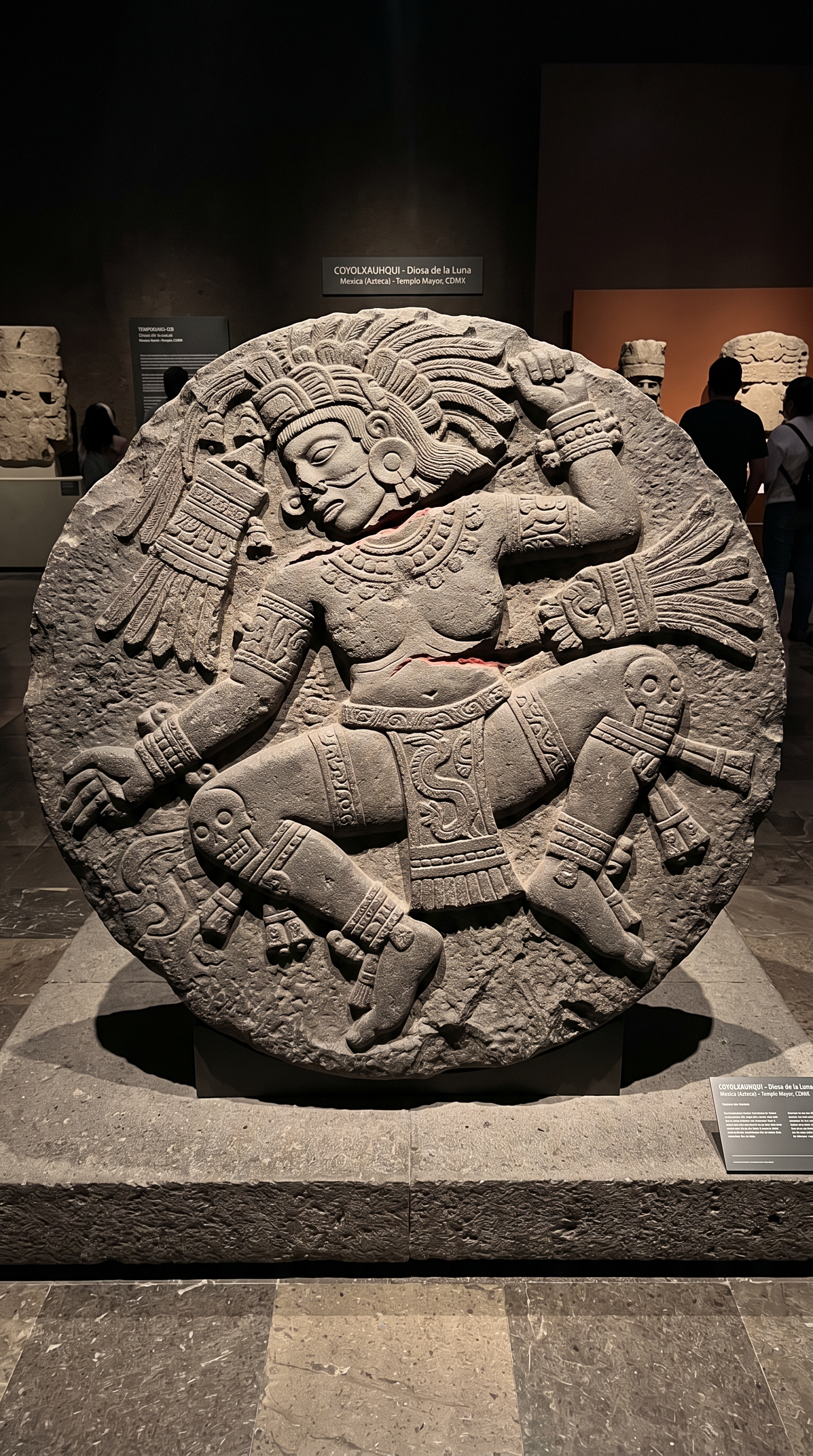
Coyolxauhqui's name is generally translated along the lines of “She Who Is Adorned with Bells” or “the one adorned with bells.” Her imagery reflects that name. In representations of her, one of her most recognizable features is the bell-like ornament appearing on her cheek.
She is identified as a daughter of Coatlicue and sister of Huitzilopochtli and the Centzon Huitznáhuac, commonly translated as the Four Hundred Southerners. And her best-known story begins with her mother.
Coatlicue and the Miraculous Pregnancy
According to the narrative preserved in colonial-era sources, Coatlicue was performing ritual sweeping at Coatepec, the “Serpent Mountain.” As she swept, a ball or bundle of feathers descended. Coatlicue placed the feathers against her body. Eventually the feathers disappeared. And Coatlicue discovered that she was pregnant. This pregnancy enraged her children. Coyolxauhqui and her brothers regarded their mother's mysterious pregnancy as a dishonor. Coyolxauhqui urged her brothers to kill Coatlicue. The siblings armed themselves and moved against their mother. But one brother, Cuahuitlícac, secretly warned the unborn Huitzilopochtli about what was happening. Coatlicue was terrified. Huitzilopochtli reassured her. And when Coyolxauhqui and her brothers reached Coatepec, something extraordinary happened. Huitzilopochtli was born. Not as a helpless infant. He emerged armed and ready for battle.
The Death of Coyolxauhqui
Huitzilopochtli attacked. Coyolxauhqui was defeated. Her body was dismembered. Her head was severed. Her limbs were separated from her torso. Her body was then cast down Coatepec. Huitzilopochtli pursued and defeated Coyolxauhqui's brothers as well.
It is a violent story. And we should resist the temptation to immediately soften that violence into a modern metaphor. Because violence, warfare, sacrifice, cosmic order and political authority all existed within the religious world in which this story operated.
There is also a celestial interpretation of the narrative. Coyolxauhqui has long been associated with the moon, while her brothers have been interpreted in connection with the stars. Huitzilopochtli's triumph has therefore been understood as part of an astronomical or cosmological drama: the victorious solar power overcoming the forces of night. But the story was not confined to the sky. The Mexica placed it on Earth.
The Templo Mayor Became Coatepec
This is one of the most important parts of Coyolxauhqui's story. The Templo Mayor was not merely somewhere the Mexica happened to display her image. Its architecture recreated sacred geography. The side of the Templo Mayor associated with Huitzilopochtli evoked Coatepec, the mountain where the deity was born and where Coyolxauhqui was defeated. And at the bottom of those stairs was the monumental image of her broken body.
Imagine approaching that space. Above you is the shrine of Huitzilopochtli. Below is Coyolxauhqui. She has fallen from the sacred mountain again. Myth has become architecture. Architecture has become ritual. And ritual repeatedly returns participants to myth. This is why reducing Coyolxauhqui to a list of magical correspondences misses so much of what makes her extraordinary. She existed within an entire religious landscape.
The Coyolxauhqui Stone
The most famous surviving representation of Coyolxauhqui is enormous. The circular stone relief measures more than three meters across and weighs roughly eight tons. Coyolxauhqui appears across its surface completely dismembered. Her head is separated from her torso. Her arms and legs lie apart. Her body is richly ornamented despite its destruction. You can see the bells associated with her identity, elaborate adornment, feathers, and skull imagery. This is not a peaceful portrait of a lunar goddess looking serenely toward the heavens. It is the aftermath of divine violence carved into stone. And where archaeologists found that stone transformed our understanding of Tenochtitlan.
The Night Coyolxauhqui Returned
On February 21, 1978, electrical workers were digging in the historic center of Mexico City when they encountered a massive carved stone. What they had uncovered was Coyolxauhqui. She had been buried beneath the modern city for centuries. Her discovery became one of the defining moments in Mexican archaeology. Archaeologists from Mexico's Instituto Nacional de Antropología e Historia excavated the sculpture, and the importance of the discovery helped lead to the creation of the Proyecto Templo Mayor.
Large-scale archaeological work followed. Beneath the colonial and modern city, portions of the sacred precinct of Tenochtitlan began emerging again. Temples, offerings, sculptures, ritual objects, fragments of the city that the Spanish conquest and centuries of construction had buried. In a very literal sense, Coyolxauhqui helped reopen Tenochtitlan. There is something remarkable about that. Not because we need to turn it into supernatural proof of anything, but because history itself is powerful enough. A deity represented as dismembered and cast down was found again beneath Mexico City and her discovery helped archaeologists reconstruct the sacred center in which her story had once been performed.
Was Coyolxauhqui Really the Moon?
This is where things get interesting. You will often see Coyolxauhqui introduced simply as: “The Aztec goddess of the moon.” That isn't exactly wrong. Mexican archaeological institutions themselves discuss her lunar identity and the celestial symbolism surrounding the narrative. But “moon goddess” can become misleading when it is treated as though it tells us everything we need to know about her. Religion is rarely that simple.
The surviving archaeological and textual evidence connects Coyolxauhqui with a much larger complex involving Coatepec, Huitzilopochtli, warfare, sacrifice, cosmic conflict, sacred geography and Mexica political-religious identity. She is not merely the Mexican equivalent of whatever moon goddess someone already understands from another tradition. And this is where modern spirituality can accidentally flatten Indigenous religions.
Coyolxauhqui Is Not a Generic Goddess Archetype
Search Coyolxauhqui online today and you may encounter descriptions of her as a goddess of shadow work, feminine rage, trauma healing, reclaiming the fragmented self, rebellion against patriarchy, or rebuilding yourself after destruction. Some of these interpretations have become especially meaningful in contemporary Chicana and Mexican American art, literature and feminist thought. That deserves its own conversation.
Cultures continue interpreting their inherited symbols. Mexican and Chicana thinkers are not required to freeze Mexica imagery in the fifteenth century. But we need to distinguish between modern interpretation and documented Mexica religious practice. Those are not the same claim.
Saying “Coyolxauhqui's dismemberment speaks to me as a symbol of reconstructing the self” is a modern spiritual or personal interpretation. Saying “the Mexica worshipped Coyolxauhqui as the goddess of trauma recovery and shadow work” would require historical evidence we do not have. That distinction matters.Especially for those of us who care about Mexican folk traditions, Indigenous history and responsible spiritual practice.
The Problem With Correspondence Culture
Modern witchcraft loves correspondences.
A deity becomes:
Color: silver
Element: water
Crystal: moonstone
Herbs: jasmine and mugwort
Moon phase: full moon
Purpose: shadow work and feminine empowerment
And suddenly an entire religious being has been transformed into something that fits neatly onto an altar card. There is nothing inherently wrong with developing a personal devotional practice. There is something wrong with presenting modern inventions as ancient Mexican tradition. Coyolxauhqui deserves more than that. So does Coatlicue. So does Huitzilopochtli. So do the religious traditions of the peoples who actually lived in Mesoamerica. If we are going to approach these figures today, the first offering should perhaps be learning who they were before deciding what we want them to become.
A Goddess in Pieces
Coyolxauhqui's body is one of the reasons she has become such a powerful symbol in modern thought. She is literally fragmented. Head. Torso. Arms. Legs. Separated across stone.
It is understandable that people look at her and see something of themselves. Colonization fragments. Migration fragments. Assimilation fragments. Families become separated from language, religion, land, history and ancestral knowledge. Many Mexican Americans grow up encountering pieces of our history rather than an uninterrupted whole. A Nahuatl word here. A Catholic devotion there. A grandmother's remedy. A story somebody half remembers. An archaeological image on a museum wall. A ritual nobody can quite explain anymore. Then, as adults, some begin trying to understand where those pieces came from. There is genuine power in seeing Coyolxauhqui through that lens. But again, we can say something meaningful without pretending it is ancient doctrine. We can allow history and modern interpretation to sit beside one another without forcing one to masquerade as the other.
Coyolxauhqui Was Never Truly Lost
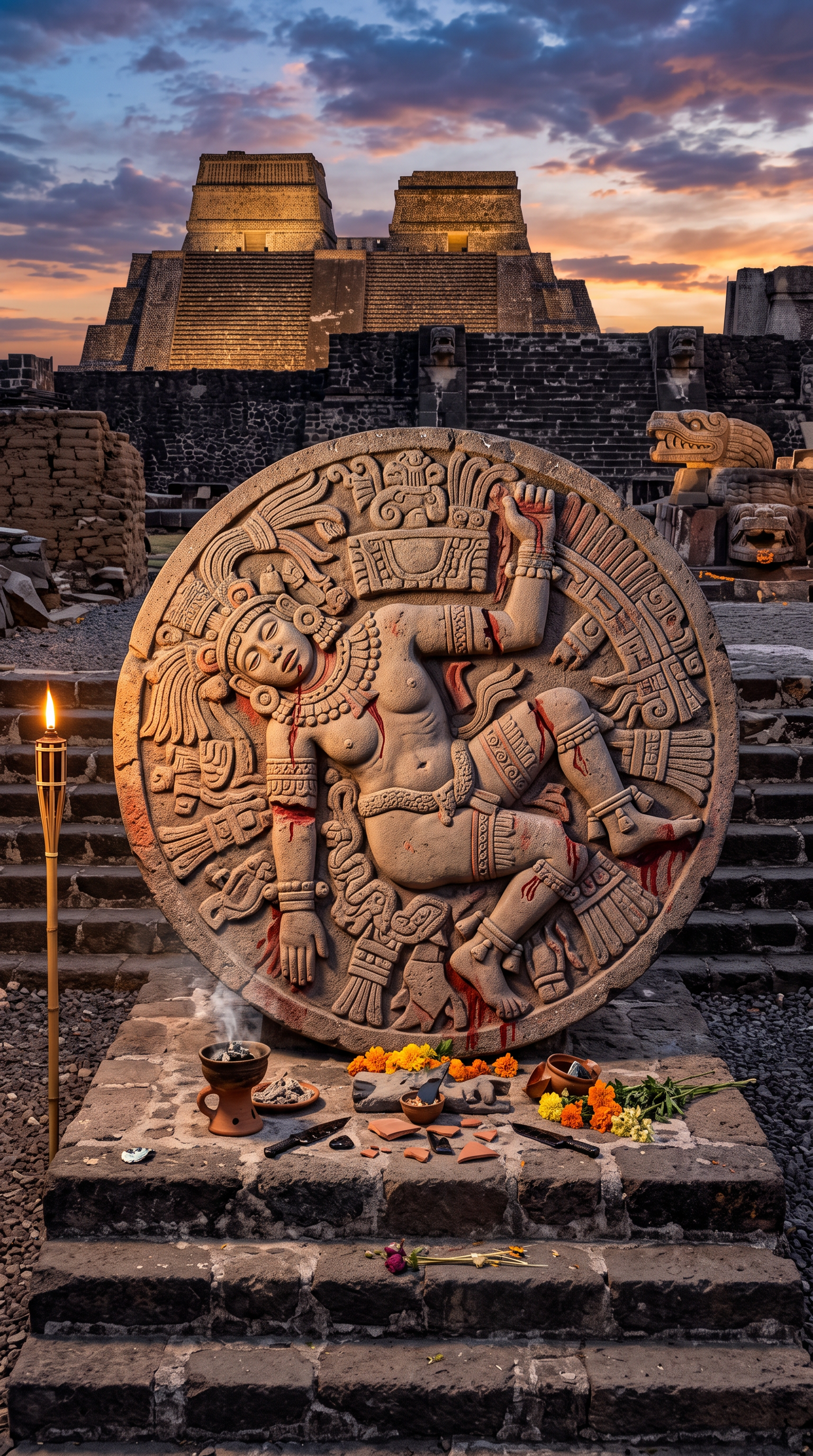
When the Coyolxauhqui stone emerged in 1978, she had spent centuries beneath a city transformed by conquest, colonization and modernization. Above her stood another Mexico. Below it remained Tenochtitlan. That image has always stayed with me. Because Mexico is like that. Layers upon layers. Indigenous. Colonial. Catholic. African. European. Folk. Modern. None perfectly replacing what came before. And beneath Mexico City, the old sacred center was still there. Coyolxauhqui was still there.
Her discovery did more than reveal a spectacular sculpture. It helped open one of the most important archaeological investigations of Mexica civilization and allowed scholars to better understand the relationship between myth, ritual and architecture at the Templo Mayor. Perhaps that is the part of her story I find most compelling.
We do not need to reinvent Coyolxauhqui to make her powerful. Her actual story is already powerful. She is daughter. Sister. Adversary. Celestial being. Defeated deity. Sacred image. Monument. Archaeological revelation. And now, centuries later, a symbol interpreted again and again by descendants and communities still negotiating their relationships with Mexico's Indigenous past.
There is room for those modern conversations. But there should also be room for Coyolxauhqui herself. Not the sanitized moon maiden. Not a correspondence list. Not an “Aztec version” of a European goddess. Coyolxauhqui. Broken across a massive stone at the foot of the Templo Mayor. Waiting beneath Mexico City until the earth revealed her again. And reminding us that before we turn our ancestors' gods into metaphors, we should learn their stories.
