
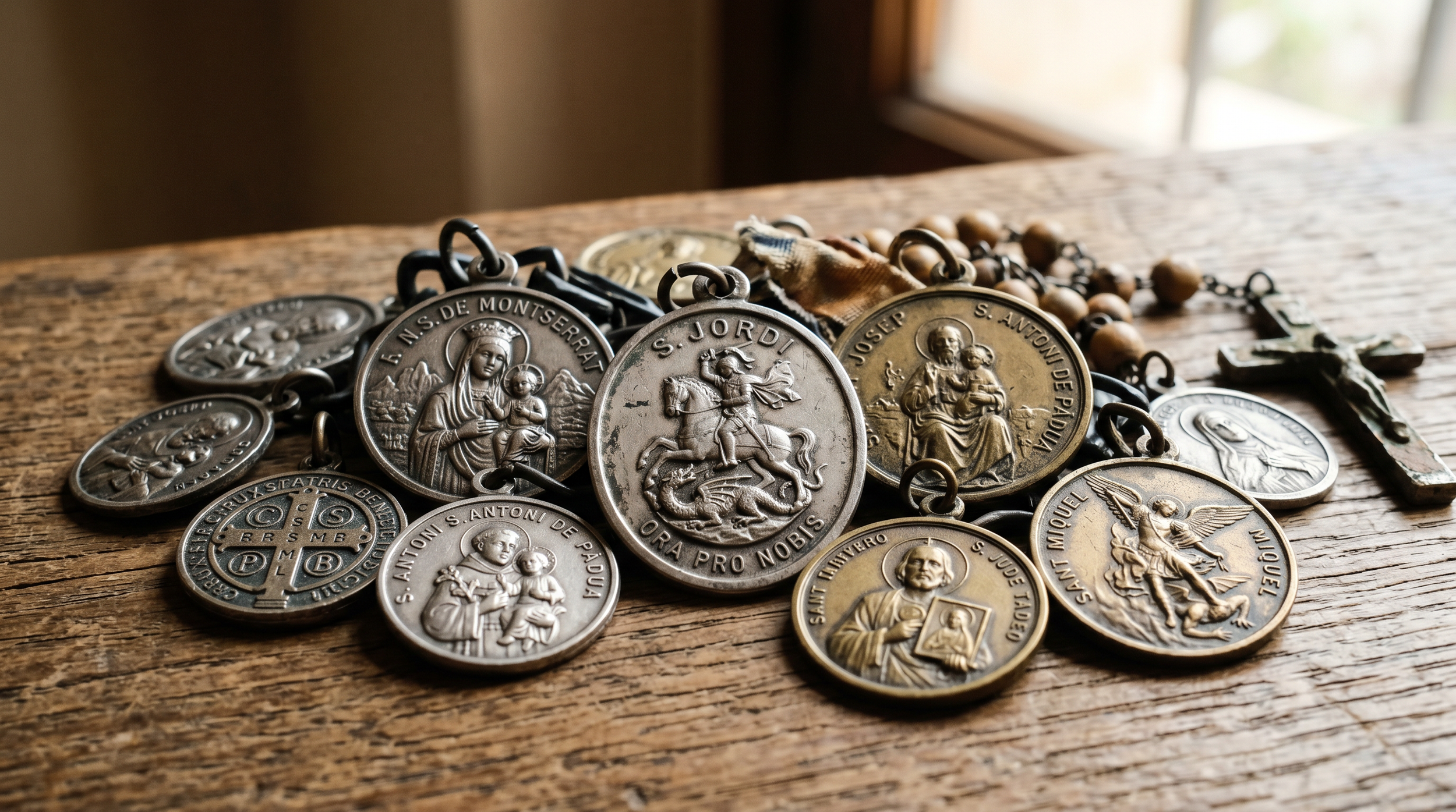
In many spiritual spaces today, saint medals have become aesthetic.
They are placed in self-care boxes, sold in curated kits, added to jewelry for visual appeal, or used in workings without understanding their origin or weight. What was once sacred becomes decorative, what was once devotional becomes consumable.
But in Catholic tradition, saint medals are not just objects. They are sacramentals, items set apart, blessed, and intended to mediate spiritual grace through devotion and reverence.
And how they are treated matters.
What the Church Actually Says About Sacred Objects
According to Code of Canon Law, sacramentals are to be treated with respect because they are dedicated to divine worship.
Canon 1171 states (paraphrased for clarity):
Sacred objects, which are designated for divine worship by dedication or blessing, are to be treated reverently and are not to be employed for profane or inappropriate use, even if owned privately.
That last part is key.
Ownership does not equal permission to repurpose.
Once something has been blessed or designated as sacred, its use is no longer neutral.
What Counts as Disrespect?
Disrespect is not always loud or intentional. Often, it shows up in subtle, normalized ways—especially in spiritual marketplaces and curated practices.
Here are some common examples:
1. Placing Saint Medals in Random or Themed Boxes
Including saint medals in “self-care kits,” aesthetic bundles, or generalized spiritual boxes without context reduces them to accessories.
A medal of Saint Benedict or the Virgin Mary is not equivalent to a bath soak or candle. It carries specific devotional meaning and spiritual function.
Removing it from that context strips its purpose.
2. Using Medals for Unrelated or Inappropriate Workings
Saint medals are not interchangeable tools.
Each saint has specific patronage, history, and relationship to those who venerate them. Using a medal simply because it “feels right” or matches an intention, without connection or understanding, can be seen as misuse.
In traditional practice, relationship comes before request.
3. Commercializing Without Devotional Integrity
Selling saint medals purely for profit, especially in mass-produced or trend-based ways, raises deeper concerns.
There is a long-standing tension in Catholic teaching around simony, the act of profiting from sacred things. While selling religious goods is not inherently forbidden, removing them from devotion and turning them into aesthetic commodities crosses into ethically questionable territory.
When the sacred becomes branding, something is lost.
4. Treating Blessed Objects as Disposable or Decorative
Tossing medals into drawers, mixing them with unrelated items, or wearing them purely as fashion without acknowledgment of their meaning reflects a lack of reverence.
Sacramentals are meant to be engaged with intentionally, not passively consumed.
Do Misused Medals Lose Their Sacredness?
This is where nuance matters.
A blessed object does not simply become “unblessed” because it is misused. However, its purpose is violated, and the person using it may be acting outside of proper reverence.
In cases where an object is damaged, discarded, or no longer intended for sacred use, Catholic tradition does provide guidance:
Sacred objects should be disposed of respectfully, typically by:
Burning
Burying in the ground
Placing in a church for proper handling
This is not about punishment, it is about returning the object to the earth in a dignified way rather than allowing it to be treated as trash.
The idea that all misused medals must be destroyed immediately is an oversimplification. But the principle remains:
once something sacred is no longer treated as such, it should not continue to be used casually.
A Brujería Perspective: Relationship Over Aesthetic
For practitioners who work with saints within brujería, this conversation goes even deeper.
Saints are not symbols, they are spirits with agency.
Working with them requires:
Consent (through relationship)
Offerings
Respect for their history and roles
Ongoing devotion, not one-time use
A medal, in this context, is not just a representation, it can act as a point of connection.
To use it without relationship is not just improper, it can be spiritually ineffective at best, and disruptive at worst.

Reclaiming Respectful Practice
This is not about gatekeeping or fear, it is about integrity.
If saint medals are part of your practice, consider the following:
Learn Before You Use
Understand who the saint is, what they represent, and how they are traditionally honored.
Be Intentional with Placement
Keep medals in spaces of respect, altars, devotional areas, or worn with awareness.
Avoid Trend-Based Use
Not everything sacred needs to be part of a product, post, or aesthetic.
Build Relationship
If you’re going to work with a saint, engage beyond the object. Prayer, offerings, and consistency matter.
Dispose with Dignity When Needed
If a medal is broken, unwanted, or improperly used, do not discard it casually. Return it respectfully.
Closing Thoughts
Saint medals are not neutral objects.
They exist at the intersection of devotion, history, and spiritual practice. When treated with care, they can be powerful tools of connection. When treated casually, they become disconnected from their purpose.
Respect is not about perfection, it is about awareness.
And in spiritual work, awareness is everything.
